Need Flexibility? We Deliver.
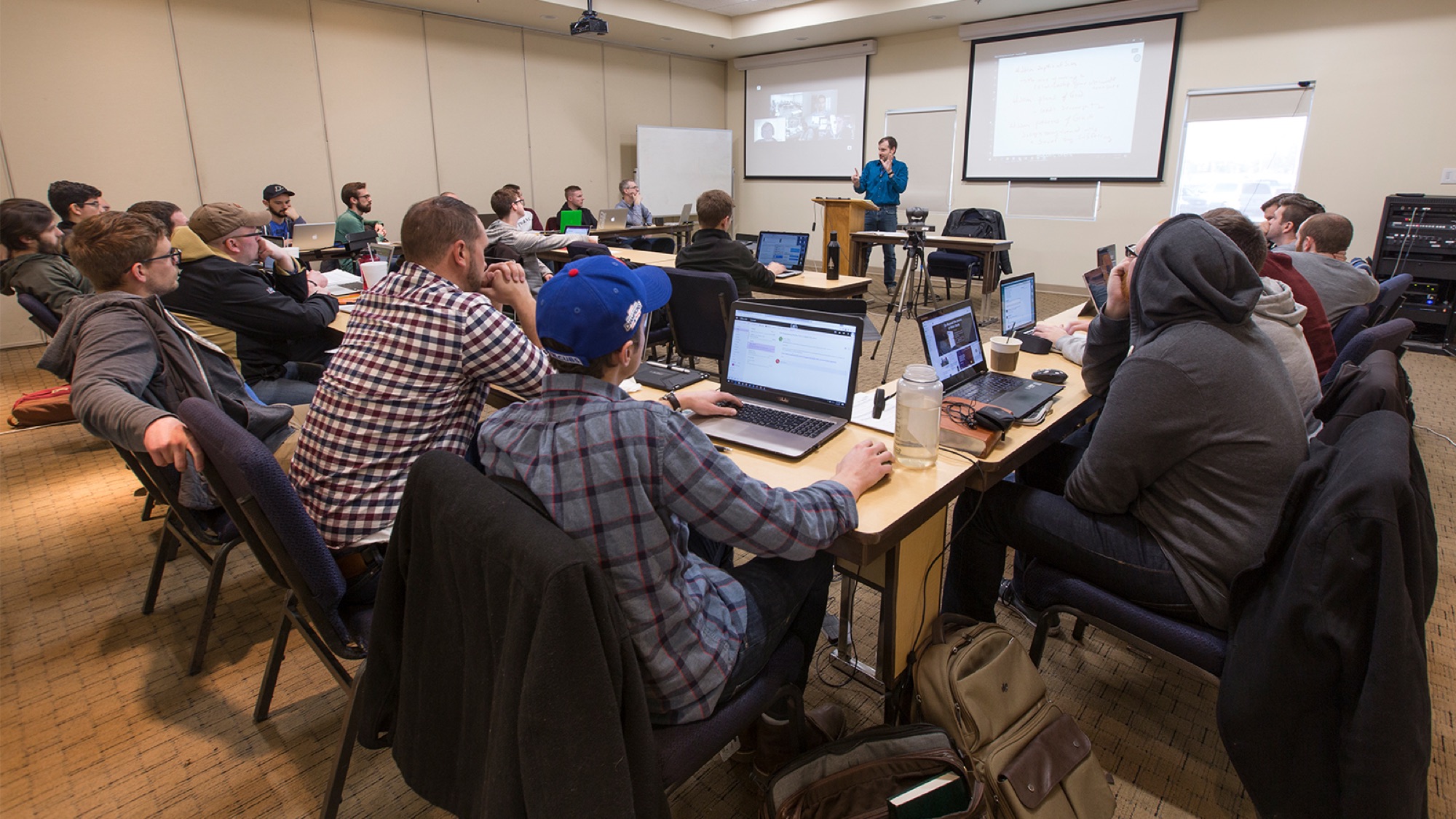
The MABC combines online-only courses with web-enhanced residency courses, so you do most of your course work from wherever you are and make only a few trips to Lafayette for your training — five weeks on campus over the whole degree.
Three Ways a Course Is Delivered
The twelve courses of the 39-credit MABC are delivered in three formats. Five are fully online, five include a residency week in Lafayette, and two are independent studies.
Online Courses
Complete all of the course work from the convenience of your own home, on a flexible schedule, through the FBS learning management system.
- Eight weeks long
- Lectures can be attended live or watched as a recording
- All work submitted through the learning management system
Residency Courses
Fifteen weeks long, with one week of on-campus work in Lafayette, Indiana. The rest of the class is completed online.
- One week on campus, Monday 1–5 PM through Friday 8–11 AM (about 31 hours of instruction)
- The remaining weeks are completed online from home
- Residency weeks fall in June and January
Independent Study
Complete the course from home while being supervised by a professor.
- Completed from your own location
- Supervised by an FBS professor
- Two of the twelve MABC courses
Learning together, off campus
Peer review
Depending on the professor, students review the work of their fellow students and offer appropriate suggestions — a tremendous learning opportunity off campus.
Online discussion
FBS uses its learning management system to coordinate student discussions during the external residency of each course.
Live or recorded lectures
Online lectures can be attended live or watched later as a recording, so the program fits around ministry and work.
Only Five Weeks on Campus
Across the entire program you spend only five weeks in Lafayette — three in June and two in January — one week for each of the five residency courses. Everything else is completed online from home.
Three weeks in June
The spring semester’s residency courses meet on campus in consecutive weeks in early-to-mid June.
Two weeks in January
The winter semester’s residency courses meet on campus in consecutive weeks in early-to-mid January.
Monday afternoon to Friday morning
Each residency week runs Monday 1–5 PM through Friday 8–11 AM, about 31 hours of instruction.
From First Course to Concentration
The 39 credits move from foundations to theory to supervised practice, and finish with a concentration you choose after your exams.
Foundation courses (15 credits)
BC505 Introduction to Biblical Counseling, BC506 Principles of Bible Study, BC507 Theology of Biblical Counseling, BC508 Methods of Biblical Change, and BC509 Spiritual Formation and Self-Counsel.
Counseling theory (12 credits)
BC510 and BC511 Common Counseling Issues I and II, BC512 Marriage and Family Counseling, and BC513 Advanced Counseling Issues.
Counseling practice (6 credits)
BC611 Counseling Lab, then BC701 Supervised Counseling — a practicum done within your own ministry context, with 30 supervised one-to-one sessions of one to one-and-a-half hours each.
Oral and written exams
Completed as part of BC701. Once you pass, you choose the concentration that is right for you.
Concentration (6 credits)
Both classes in your chosen concentration — Counseling, Training, or Thesis — to finish the 39 credits.
Pacing the program
- Most students finish in four to five years.
- Courses are offered every spring and winter semester.
- You may take up to three classes a semester, but never more than two at the same time.
- Syllabi are provided four weeks before the start of classes.
Want to see what a course looks like? Contact Kirk Fatool at [email protected] for a sample syllabus.
Choose the Way You Finish Your Degree
Every MABC student chooses the project that is right for them: finish with a concentration in counseling practice, in training others, or by authoring a thesis. You choose after completing your oral and written exams.
Counseling Concentration
6 credits- BC720 Advanced Counseling Practice 1
Seeks to improve the student’s counseling competence. Students must be finished with the counseling supervision from BC701 before taking this class.
- BC721 Advanced Counseling Practice 2
Also seeks to improve the student’s counseling competence, and likewise requires that the BC701 counseling supervision be finished first.
Training Concentration
6 credits- BC750 Equipping Biblical Counselors for the Church and Community 1
Work through a planning cycle within your ministry context — launching or improving a ministry — by examining its strengths, weaknesses, opportunities, and threats, then crafting a strategic plan used in BC751.
- BC751 Equipping Biblical Counselors for the Church and Community 2
Put into practice the four-fold model for launching, leading, and overseeing one-another ministry: envisioning, enlisting, equipping, and empowering God’s people for the personal ministry of the Word.
Thesis Concentration
6 credits- BC790 Thesis Proposal
Guides you through the proposal-writing process with the goal of an FBS-approved proposal.
- BC800 Master’s Thesis Project
Using the proposal created in BC790, complete a thesis under the guidance of a supervisor. Prerequisite: BC790.
You must complete both classes in your chosen concentration to graduate. Concentration classes cannot be combined — a student who completes BC720 and a class other than BC721, for example, will not graduate. Full course descriptions are in the FBS catalog.
What You Will Need
Because FBS uses a web-based delivery system, potential students are strongly encouraged to have:
- A computer not more than three years old
- Access to a reliable broadband Internet service
- Because delivery is web-based, FBS cannot provide individual technical support for computer problems (the site itself is kept working)
Graduation Requirements
To earn the Master of Arts in Biblical Counseling, a student must:
- Complete 39 credit hours with a minimum 2.5 GPA
- 30 hours of supervised counseling, through BC701
- Complete one concentration (both of its classes)
- Demonstrate godly character according to Scripture
Pursuing ACBC Certification?
Students who want to be ACBC certified find the BC701 supervised counseling practicum an ideal opportunity to complete ACBC's supervision requirements, and FBS provides the observation videos and exam materials you need. Contact FBS to find out how to complete your ACBC requirements concurrently with the MABC.
Ready to Start the MABC?
Applications for the Winter 2026–27 term are due October 6, 2026, and for the Spring 2027 term March 23, 2027. Admission decisions come within two to four weeks of a complete application.
Equip Yourself for a Lifetime of Faithful Ministry
Take the first step toward a biblical education that will shape your ministry for decades to come.